headerphoto

Welcome To Walleyes For Tomorrow

Thank you for visiting the Walleyes For Tomorrow website.  Click on the tabs or the icons on the sidebars to navigate to the various pages of our site.  A lot of good information is available to you and is just a click away.

This is the twenty-year anniversary of WFT. When we started the organization, the focus was only on the Lake Winnebago chain of lakes in Wisconsin.  Poor spawning results had reduced the walleye population to levels that were of concern to fishermen.  Those of us who participated in the startup had a vision of "Increased Production" and "Making it Happen".  Happily, that is just what WFT has accomplished.  Today, our project efforts have expanded beyond Lake Winnebago and our efforts support many lake improvement projects throughout the state of Wisconsin and the UP.

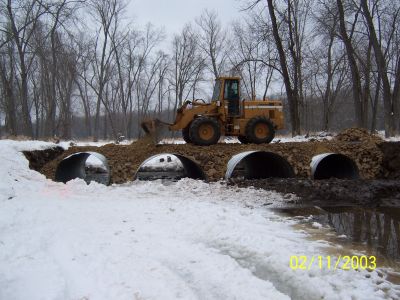
WFT is a project-oriented organization with the goal of increasing the population of walleye in the waters where habitat projects are undertaken.  From our first project, the Eureka Dam Project, WFT has been actively promoting more robust walleye populations through spawning habitat construction, enhancement and rehabilitation.

All this is accomplished by dedicated individuals who believe in our original vision.  Thousands of volunteers and members have donated their time and talents to raise funds for projects that will benefit walleye.  The effort of all who have helped in the past or are active today is very much appreciated.  WFT is a totally volunteer organization with a penchant for project implementation. 

Projects require funds to complete.  And the WFT chapters are the backbone of this effort.  Just as with the parent organization, the chapters of WFT have been blessed with an amazing group of volunteers who support WFT.  Today 14 chapters have organizing committees that give their time and talents to raise the funds necessary to “Make it Happen”.  Without them nothing would be accomplished.

The Wisconsin Department of Natural Resources is a major factor in the success of WFT.  Employees at all levels of the Department have supported WFT, our vision and our enthusiasm.  Without their help, knowledge and involvement the success of WFT would have been much more difficult or even impossible.

One only has to look at the project list to realize the potential of dedicated individuals working toward a unified goal. As Walleyes For Tomorrow moves into the next decade of operation, all that have supported the organization can feel a sense of pride in past accomplishments.  With WFT, "Making it Happen" is more than a slogan, it is a promise.

~ Mike Arrowood - Chairman, WFT.


Latest Article: Walleye Ageing Study By Mike Arrowood

In 2008 Ron Brusch the Winnebago System Team Leader from Oshkosh approached WFT about funding a study to accurately determine the age of walleye in Lake Winnebago.

Ron had spent the past 5 years working on his PhD in biology from UW Milwaukee.  He had worked on a method of more accurately ageing sturgeon using the otolith (o-ta-lith) in the sturgeon.  Essentially what Ron did was compare the growth rings on the otolith to the growth rings on the fin bones of sturgeon.  In doing so he determined that the age of older sturgeon was much older than had been estimated using the fin bone ageing method.  As much as 20 years off on an 80 year old sturgeon.  Using this more accurate ageing method he was able to more accurately estimate sturgeon populations and even back calculate what the populations were in the past.

The otolith is an "inter ear" bone in the head of all fish and vertebrates.  Technically it is called a calcareous concretion in the internal ear of vertebrates and in the balancing organ in some invertebrates.  Every year a new "growth ring" is added to the otolith.  Because this bone is in the tissue of the head of fish, there is no wearing away of the growth rings so a very accurate count is more easily made.

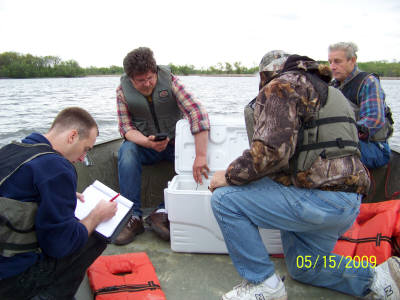
Ron's idea was to remove otolith from walleye and compare the age estimation from the otolith to the age estimation from a removed dorsal fin.  It requires dead walleye to have a supply of otolith for the study.  Enter the Merc National, Otter Street and many local fishing tournaments on Lake Winnebago.  Each tournament has dead walleye that can be used as a source for otolith.

Ron proposed that WFT fund the removal of the otolith, work to age them, the work to make the age comparison and the eventual dissemination of the completed study. In 2008 the WFT Board of Directors agreed to fund the study.

Ron selected Ryan Koenigs, a DNR LTE (limited term employee) from the Oshkosh Work Group to undertake the study. Ryan is a UW Stevens Point graduate and a native of Calumet County.  Ryan is using the study as his research topic while working on his Masters Degree at UW Oshkosh.

For the past two years Ryan has been removing the otolith and second dorsal spine from dead walleye at fishing tournaments around Lake Winnebago.  He must remove a number of otolith and spines from each ½ inch size class of walleye.  This ranges from 6" fall fingerlings to 30" mature fish.  It requires a number of samples from each size class to get a reliable sampling of age to size comparisons.

The removed otolith is stained and the "growth rings" are counted using a dissecting microscope.  The removed dorsal spine is very thinly sliced, stained and the "growth rings" are counted.  The "true age" of the otolith is the compared with the estimated age from the dorsal spine.

Dorsal fins and scales have been the traditional material used for ageing walleye across the nation since fish ageing started.  As fish age, the year one or two growth rings become more and more indistinct so accurate ageing is really an estimated guess.  The same with scales.

Ryan is well on his way to making a scientific comparison to the two ageing methods.  The new method will allow fisheries biologists to still use spines from live fish for ageing but will now have a reference to compare the estimated fin age with the known true age.

When complete the study may very well revolutionize the way walleye are managed across the entire United States. 


Walleyes For Tomorrow Mission

The mission of WFT shall be to work with other clubs, agencies, and the DNR to improve the quality of walleye and sauger fishing.

This may be achieved by, but not limited to the following goals or methods:
  • Water quality and habitat improvement
  • Construction and/or improvement of spawning areas
  • Spawning protection
  • Stocking
  • Studies and research